

The short answer
THERE IS NO SINGLE WINNING BODY PART.
Men may notice a woman's face, expression, hair, silhouette, waist and hips, legs, movement, clothes, or voice. What turns that first look into attraction is the way those signals arrive together. A smile changes a face. Posture changes an outfit. Movement changes a body shape. Confidence changes the whole read.
Physical attraction is real. It is simply more like a composition than a checklist.
The shift
FIRST NOTICE IS NOT THE WHOLE STORY.
A first impression can begin with what is visible. A real interaction adds a different kind of information.
What lands quickly
Expression, style, grooming, posture, movement, and body cues can shape an immediate read.
What changes the read
Conversation, warmth, humor, responsiveness, and ease can add to—or change—that first impression.
What becomes memorable
There is no feature or behavior that guarantees attraction. Individual taste, timing, and context still matter.
Three different questions
LOOKING IS NOT THE SAME AS LIKING.
Research can track the first fixation, total looking time, or an attractiveness rating. Those measurements do not mean the same thing.
What grabbed the eye?
Contrast, movement, shape, color, or a face can win the first fraction of a second.
What held attention?
A body region can contain useful visual information without becoming the favorite feature.
What was judged attractive?
The observer combines the visible information into a broader impression.
In eye-tracking experiments with female body images, the face, breasts, waist, and hips have all drawn attention. One restricted-viewing study found the largest shift toward the hips, followed by the face and breasts. Another experiment found that first fixations were more likely to land on the breasts or waist, while only breasts received more frequent and longer looks in that task.
That tells us which information people sampled in those tasks. It does not prove that the first body part seen is the part a man values most in a real person. A loud jacket can catch the eye before a beautiful smile. A dramatic outline can be visually obvious while a voice or laugh becomes the feature someone remembers.
The attraction map
SIX ZONES, ONE MOVING PERSON.
The markers are reading directions, not a ranking. Every region changes when expression, clothes, posture, and movement change.
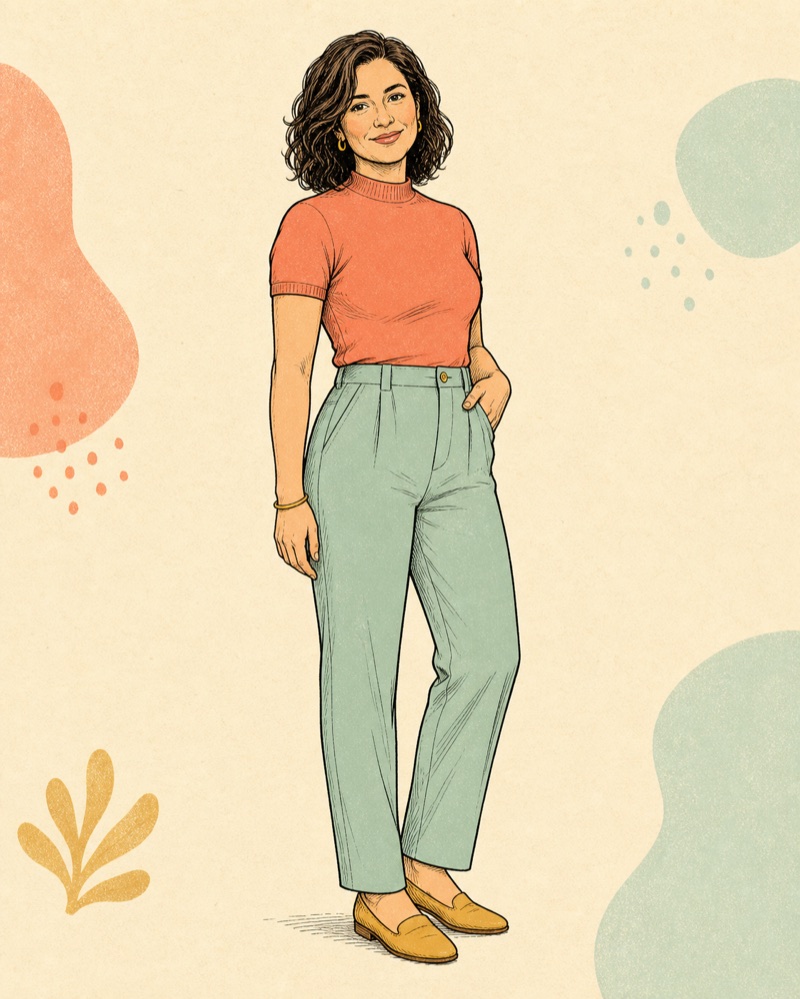
Expression does the heavy lifting
Eye contact, a smile, animation, and apparent mood can make the same face feel completely different.
The frame around the face
Texture, movement, cut, color, and the way it is worn become part of personal style.
Shoulders, neckline, and posture
Clothes can sharpen, soften, reveal, or redirect the broad outline.
A dense area of shape information
Research returns here often, but height, build, stance, and clothing change how the proportions read.
Small cues with personality
Gesture, jewelry, fabric, shoes, and color can signal boldness, ease, precision, or playfulness.
The still image starts moving
Walking, shifting weight, dancing, and sitting can matter more than a frozen outline.
The useful distinction: a visible feature can draw attention; the person gives it meaning.
Body shape
THE WHOLE SHAPE MATTERS MORE THAN ONE MEASUREMENT.
People read body fat, muscle, proportion, posture, movement, and clothing at the same time.
What experiments can isolate
One online experiment with more than 34,000 participants varied weight, bust size, waist width, hip width, and leg length independently. Men and women showed some average differences, but several were small.
The study shows that observers combine multiple dimensions. It does not hand the world one ideal female body.
What a live encounter adds
Culture, fashion, confidence, expression, smell, voice, and the meaning of the interaction enter the picture. Internalized beauty ideals also predict part of the variation in body judgments.
That is why different heights, builds, curves, muscle levels, and styles can all become highly attractive.
So, what female body shape do men find most attractive? Many controlled studies find recurring interest in waist and hip proportions. There is still no single build that wins across every sample, culture, image set, and person.
Research chart
EVEN A NARROW QUESTION PRODUCED FOUR DIFFERENT GROUPS.
A 2026 study asked 395 Norwegian men how important breasts and buttocks were when evaluating romantic partners.
A shareable view of the four latent profiles in this sample. The study measured two body features, not every source of attraction.
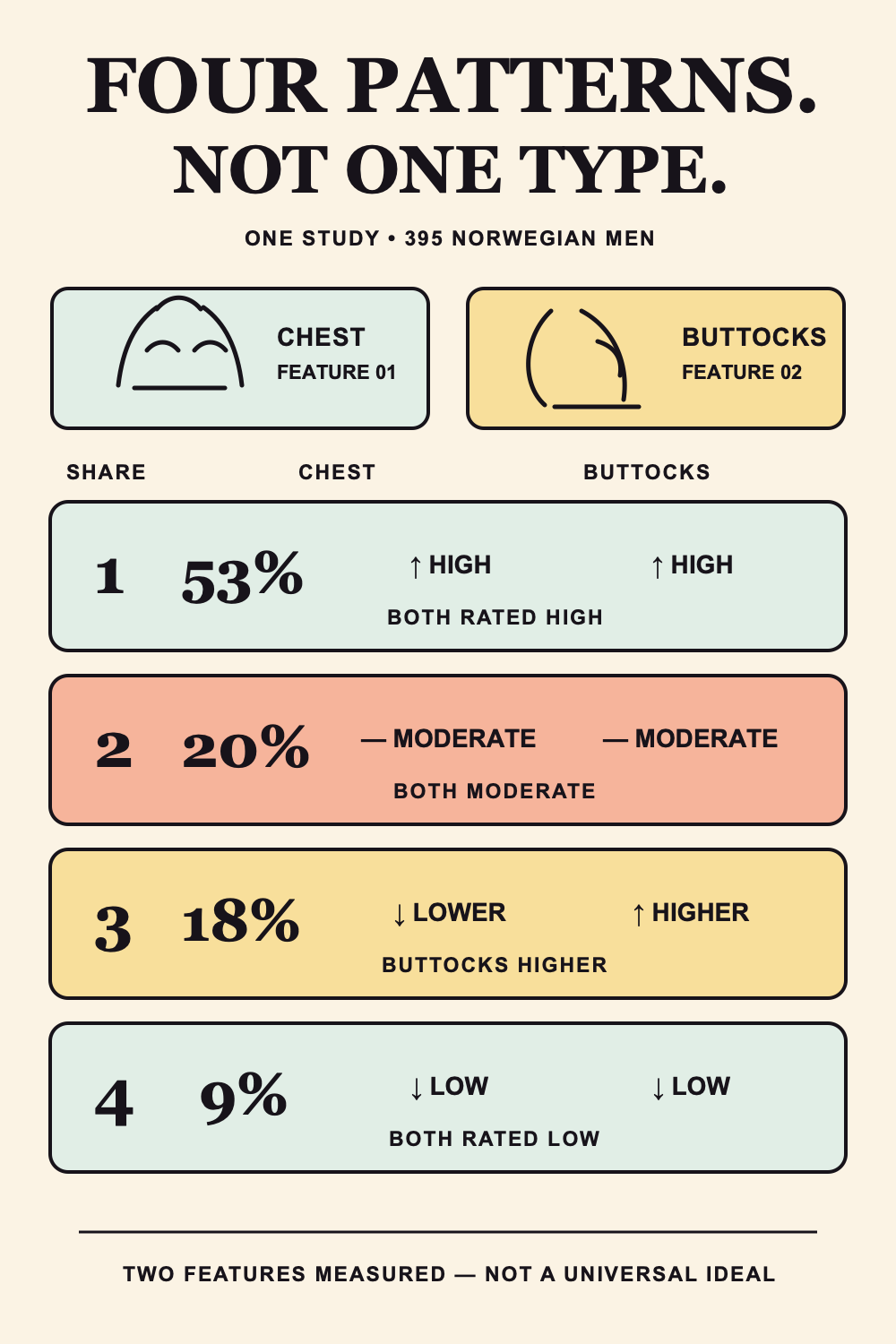
View chart data and study scope
| Profile | Share | Meaning in this study |
|---|---|---|
| Highly body-oriented | 53% | Both features received high importance |
| Moderately body-oriented | 20% | Both mattered, but less strongly |
| Buttocks-oriented | 18% | Buttocks received more importance than breasts |
| Body-unoriented | 9% | Neither feature received much importance |
This was a convenience sample of Norwegian men and the model used only two features. It cannot represent all men or rank the rest of the body.
Source: Mehmetoglu, 2026. Original NO BLUSH chart from the CC BY 4.0 study data; no source graphic reused.
The useful result is the variation. More than half rated both features highly, one group favored buttocks, one group rated both moderately, and one group placed little importance on either. The analysis did not find a separate breasts-only profile.
This is more informative than declaring that all men are visual and stopping there. Some men place strong weight on particular body features. Others distribute that attention differently. Some care little about the two features the study asked about.
The body in real life
VOICE, MOVEMENT, AND STYLE CAN CHANGE THE BODY.
A face and body are not judged in independent boxes. Social presence keeps changing the visual impression.
A face may look more compelling when posture feels open. An outfit may work because it matches the person's movement. A body may become more attractive after a conversation gives it a voice and personality.
A still image removes the timing of a smile, the rhythm of a walk, the way hair moves, and the posture shift that happens when someone becomes interested. It also freezes fabric. In motion, clothes fall, catch light, reveal shape, and hide it again. A person can look ordinary in a profile photo and magnetic across a room.
Voice belongs in the visual story because people watch a face while listening. Mouth, eyes, brows, hands, and shoulders respond to speech. Once a distinctive laugh becomes inseparable from a face, attraction is no longer a judgment of isolated features.
Style adds another layer. Fit can emphasize a waist or create a straighter line. Color can pull attention toward the face. Jewelry can make the hands and neck more noticeable. The strongest cue is often coherence: the clothes look as though they belong to the person, not to an imagined audience.
There is also a difference between what catches the eye and what keeps someone attracted. Immediate visual salience favors contrast, movement, skin, shape, color, and expression. Longer attraction adds humor, warmth, intelligence, smell, sexual chemistry, values, familiarity, and the meaning of the interaction. Physical attraction does not disappear. It gets attached to a person.
A question worth asking
4,400estimated monthly searches for this exact question
That tells us the question matters to many readers. It does not tell us what any one person prefers, or promise one universal answer.
Three myths
DROP THE UNIVERSAL ANSWER.
The research becomes more useful when it stops pretending every man is the same observer.
All men notice the same body part first.
Eye-tracking changes with the image, viewing task, body angle, and available information. A first fixation is not a universal vote.
One female body shape wins.
Average preferences move with culture, sample, body dimensions, and presentation. There is no permanent global champion.
Attention automatically creates attraction.
A feature can be visually obvious without becoming the reason someone wants another look or conversation.
Fast answers
WHAT MEN FIND ATTRACTIVE: FAQ
What body part do men find most attractive?
There is no universal winner. Hips and waist, breasts, buttocks, face, and hair all appear in research, but studies measure different things. A first look, a rating, and a long-term preference are not interchangeable.
Do men prefer face or body?
Both can matter. Faces carry expression and social information; bodies carry shape, movement, posture, and style. The balance changes with context and person.
Do men prefer curves or slim bodies?
Men vary. Controlled figure studies often find interest in proportion and waist-to-hip shape, but they do not identify one build every man prefers.
Is confidence physically attractive?
Confidence changes eye contact, posture, movement, voice, and how someone wears clothes. That can change the physical impression without changing the body.
Can physical attraction grow?
Yes. Voice, humor, smell, movement, familiarity, and shared meaning can change how a face and body are perceived.
Keep following the question
WHERE TO GO NEXT
Face, hair, shoulders, hands, movement, and a 14-muscle research chart.
COMPARE →BEYOND APPEARANCEWhat Turns People On?Map person, attention, story, dynamic, sensation, accelerators, and brakes.
MAP THE SPARK →THE SHARED FITSexual CompatibilityPlace attraction inside desire, preferences, boundaries, and communication.
EXPLORE →Research sources
- Mapping female bodily features of attractiveness. Restricted-aperture eye tracking of male observers viewing female body images.
- Eye-tracking of waist and breasts. Visual-attention task using manipulated images.
- Five independently manipulated female-body parameters. Online experiment with more than 34,000 participants.
- Buttocks or Breasts? Four preference profiles among 395 Norwegian men.
- Cultural ideal internalization and body judgments. Individual variation in adjusted-body preferences.
- Sex differences in attraction preferences across age. Self-reported preferences from more than 7,000 adults.